
 Insight
 Engage
 Convert
 Data
 Grip
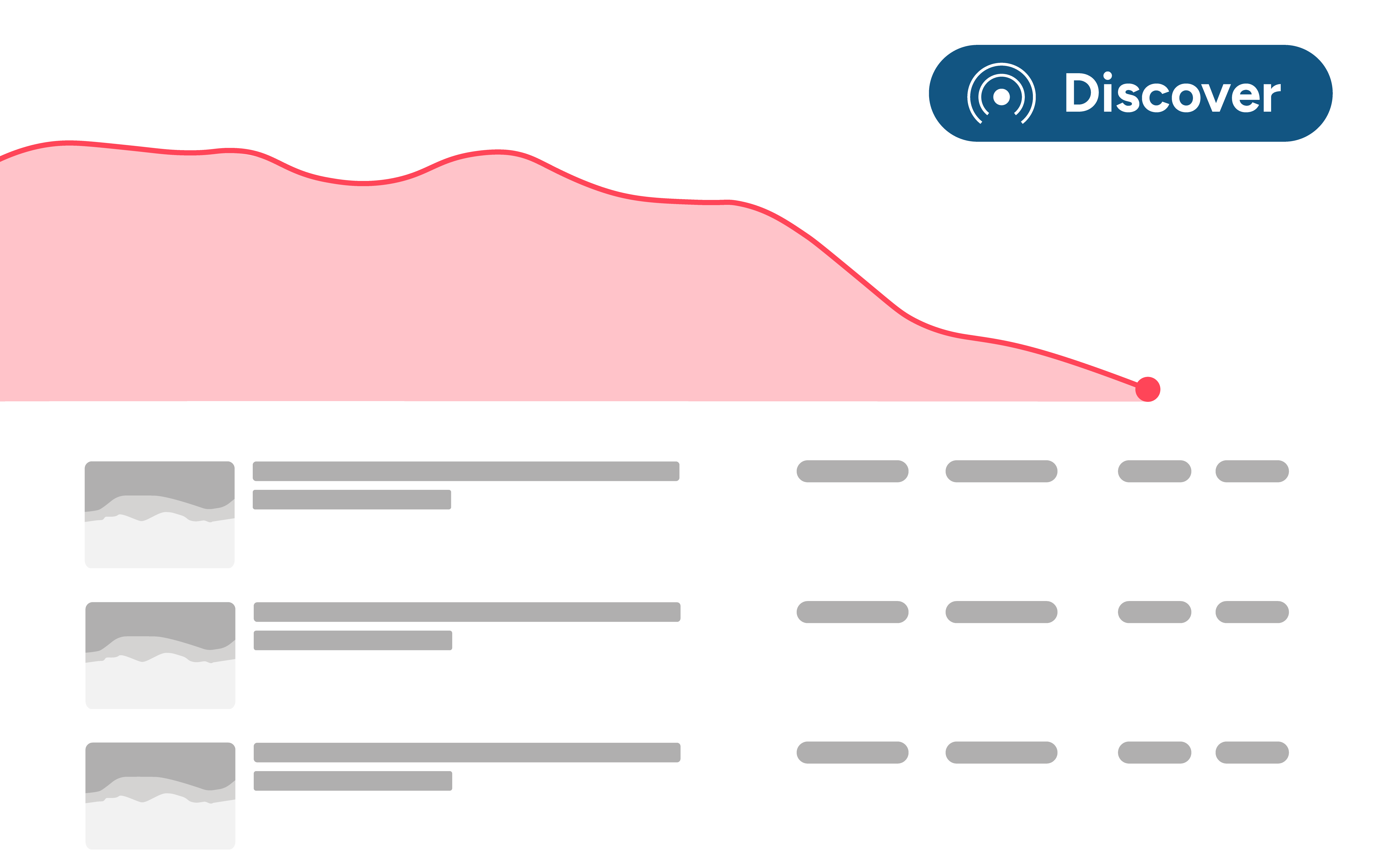
A 30 percent drop in just a few months: Is Google Discover set to become the next reach disaster for publishers? We explain why there are strong indications that this might be the case – and what steps can be taken.
From the decline of Facebook to Google Discover
Facebook was once a valuable channel for generating reach. Between the early and mid-2010s, it was common for many media outlets to derive 20 to 25 percent of their reach from what is arguably the original "social" platform. Today, those figures are typically in the low single digits. In our own benchmarks, for instance, we see a median value of around 3 percent for regional publishers.
For many publishers, the decline of Facebook as a source of reach did not pose a serious problem – because the end of Facebook was followed by the arrival of Google Discover. This convenient feed initially appeared only on Android phones but later became available on iPhones as well. What was new at the time was that Google users no longer needed to perform a search; instead, the Google Discover algorithm proactively suggested content that the individual user – while on their mobile device – would likely find interesting.
For the Discover feed, Google utilised a mix of general, national-level news, articles based on the individual user’s search history, and content tailored to the user’s current location.
Many users were thrilled: it was a pleasant way to pass the time and a valuable source of information – all without the need for active Google searches. It certainly saved the day during a subway commute.
For publishers, it often solved their reach problem, too. As traffic from Facebook declined, traffic from Discover rose. "Discover optimisation" became a buzzword – and a successful one at that. Those who actively worked on their Discover traffic often achieved record-breaking reach: a win-win for both publishers and Google.
The Downward Spiral: What’s Going Wrong at Discover?
Discover traffic is currently in a downward spiral. Our Upscore benchmarks reveal a dramatic decline. According to our data, the average drop in Germany over the eight-month period from March to October 2026 was nearly 30 percent – with some providers experiencing an even steeper decline.
The reasons for this are multifaceted. The loss of visibility occurred in several stages.
To begin with, Google introduced advertising into the Discover feed some years ago. For the first time, it became evident that Google was aggressively monetising the space surrounding content from publishers. Publishers remained quiet – even regarding the issue of ancillary copyright (neighbouring rights) – because it still felt like a win-win situation: Discover traffic continued to grow despite the presence of ad tiles, eventually becoming the primary external source of reach for many.
Then, a few months ago, links to X (formerly Twitter) entered the mix. Google began directing users from its "Discover" tiles not to journalistic articles, but to Elon Musk’s platform. Consequently, reach was diverted away from publisher content.
Over the past few months, another setback has emerged: Google has clearly slashed the duration for which individual articles remain visible in the Discover feed. While it was once not unusual for content to stay in the feed for five or six days after publication, the plug is now pulled after just two – or, at most, three – days.
This is a major problem. It not only diminishes the potential reach of individual articles but also makes it significantly more difficult for editorial teams to optimise content for the Discover feed.
Typically, optimisation used to work like this: an article would be published, and after about 24 hours, you could check its click-through rate (CTR) in Google Search Console or directly via Upscore. If the CTR was poor, you could make improvements – by tweaking the headline or the teaser image – and then "republish" the piece. By the third day, the article would typically gain more reach as a result of these optimisations.
That process no longer works, because by the third day, most articles disappear from Google Discover; the algorithm simply stops serving them.
One might argue that this merely represents a redistribution of reach rather than an overall decline – but that is not the case. A 30 percent drop across the entire market in just a few months is too significant to be explained away like that.
This might also suggest that Discover is seeing less overall usage. The more frantic delivery of articles via the algorithm could be a sign that Google is responding to a decline in engagement – though that remains speculative.
AI Tiles and the End of Click-Through Rates
What is not speculative, however, is that AI-generated tiles are coming to Discover. Numerous screenshots have appeared in SEO forums and on LinkedIn, originating from English-speaking regions. In these instances, the system selects a teaser image and synthesises text drawn from several articles on the same topic. While it is still possible to click through to an individual article, doing so is no longer necessary to learn more.
AI tiles may only be a matter of weeks before they appear on the German market. Their impact on reach via Google Discover will depend on how frequently they appear, but it could be devastating – as they leave users with little incentive to click through to the publisher’s own site. (Though, we should probably brace ourselves for a statement from Google claiming the exact opposite.)
The solution: Cultivate loyalty rather than relying on external traffic sources.
So, what can be done? In a sense, it’s time to go "old-school" using modern methods: build your own base of loyal users – one that doesn’t depend on outside traffic. Think of it as a return to the 2000s but armed with far greater knowledge and data. Insights from Upscore can be strategically applied to editorial planning, helping to boost direct and internal traffic. Newsrooms need to be trained and guided in this approach – and that’s where we at Upscore can help.
Furthermore, brands should increase their offline visibility – ranging from traditional billboard advertising and pop-up editorial spaces to live events tailored to their target audience.
Some providers may also need to consider shifting their business model, especially if it currently relies primarily or exclusively on monetising mass reach within the advertising market. How to orchestrate such a transition is a challenge we are already exploring in depth with our clients at Upscore Grip.

Example screenshot of an AI-generated tile on Discover, via Nicola Agius on LinkedIn: https://lnkd.in/p/dHYSUzVa. Particularly unfortunate in this instance: the teaser image selected by the algorithm shows neither Maya Jama nor Mo Farah, but rather Holly Willoughby. Consequently, the “Belfast Telegraph” risks losing not only reach but also reputation, as users may perceive this mismatch between image and text as an editorial error.
Joachim Dreykluft is Head of Data & AI Strategies at Upscore.