
 Insight
 Engage
 Convert
 Data
Data
 Grip
Grip
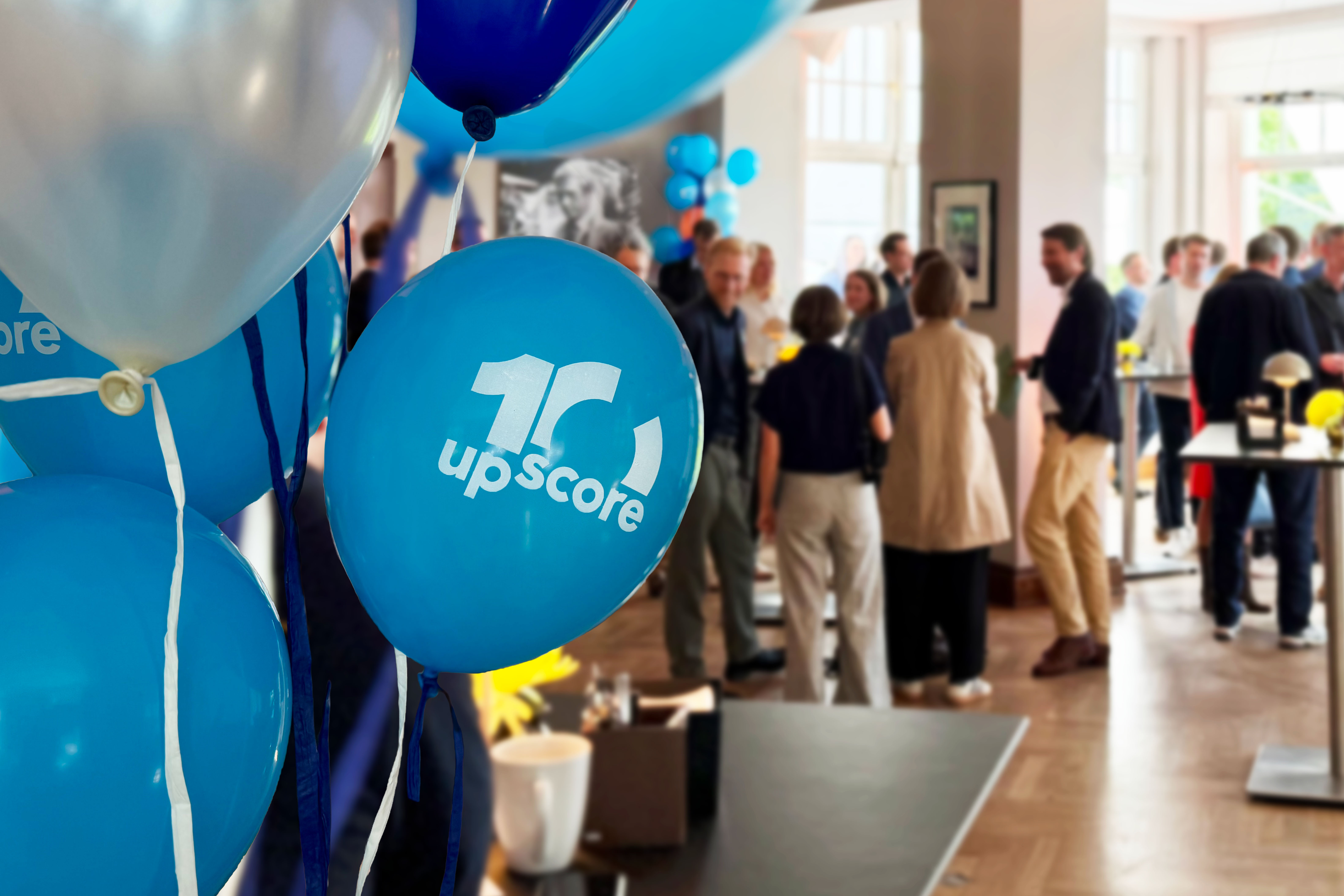
There are moments that make us realise just how far we’ve come. Our anniversary celebration at the villa in Heine Park was one of those occasions. Ten years of Publishing Intelligence, ten years filled with shared developments, ideas, partnerships, and dialogue.
When I joined Upscore, it quickly became clear to me that this platform is more than just a tool or a dashboard.
We don’t just support editorial teams with data; we turn data into guidance. And in a market that is changing so rapidly, that is becoming increasingly important.
On 20 May, that’s exactly what we talked about—with guests from media, academia, and politics. And what really pleased me: it wasn’t a stiff industry event. It was a genuine exchange—relaxed, open, honest. We were fortunate to have seven top speakers share their perspectives on the future of quality journalism with us.
The event was opened by Dr Claas Schüddekopf, Head of the Media Office of City of Hamburg, who not only addressed the economic but also the structural challenges facing journalism, and posed the question of what the public must do to ensure robust and independent journalism.
Dr Christiane Düts, CEO of Der Freitag, gave us an exceptional insight into the publication’s long journey into the digital world and demonstrated how, with Upscore, it has been possible to make data truly tangible for editorial planning. Der Freitag shows how data-driven decisions can make a reader-financed future feasible.
There was no beating about the bush on the panel.
Ann-Kathrin Liedtke, responsible for Membership Growth and Paid Strategy at taz, shared how taz completed the digital transformation of its daily print edition with a conversion rate to digital subscription models of 88%—well above expectations—and, in the process, turned many staff members into iPad experts.
Arist von Harpe, publisher of the Hamburger Morgenpost, spoke about two years of intensive transformation. In 2024, Mopo discontinued its printed daily edition and has since focused heavily on digital. This brings its own set of challenges, which Arist von Harpe illustrated very clearly.
What preoccupied me most on a personal level was the question of AI and responsibility. Johannes Vogel, Chief Product & Revenue Officer at Stern, GEO, and Capital, put it very clearly: If we allow uncontrolled AI to undermine the funding of quality journalism, sooner or later, reliable facts will disappear. This isn’t a technical debate. It’s a societal one.
Cordula Schmitz, Digital Editor-in-Chief at the Hamburger Abendblatt, emphasised that local media have a genuine advantage because of their close connection to their readers. It’s a strength that even AI cannot easily disrupt. She summed it up with one of her key theses: local journalism holds the “analogue monopoly”—a real presence on the ground that no AI can replace.
And then there’s the question: Do young people even want quality journalism anymore? As a member of Generation Zillennial, I naturally have my own perspective on this. According to Prof Dr Christopher Buschow, Head of Digital Journalism at the Hamburg Media School, it’s less a matter of interest and more one of the right formats. Journalism needs to engage more closely with the everyday lives of young people. I would agree: Yes, absolutely. We do want good journalism—we just don’t want to have to search for it.
Upscore has continuously evolved over the past ten years—technically, conceptually, and always in close collaboration with our clients. Today, over 350 media brands in nine European countries use Upscore. But more important than any figure is our mission: strengthening digital quality journalism. With technology that works, and a team that listens and thinks along with you.
Our Managing Director, Andreas Demuth, summed it up beautifully at the end: We are actively shaping digital transformation—with creativity, technology, and trust.
After ten years, a wonderful evening, and many fruitful conversations, we are proud of what we have built. And at the same time, we are excited for what lies ahead.
The evening ended just as it began: with genuine conversations, new acquaintances, good food, and a fantastic party. This is exactly what makes for a great industry event—people coming together, exchanging ideas, sharing laughter. And going home with the knowledge that there are so many others out there who believe in the same values.
Here you can find the impressions from our anniversary.
Singa Feder is Marketing Manager at Upscore.