
 Insight
 Engage
 Convert
 Data
Data
 Grip
Grip
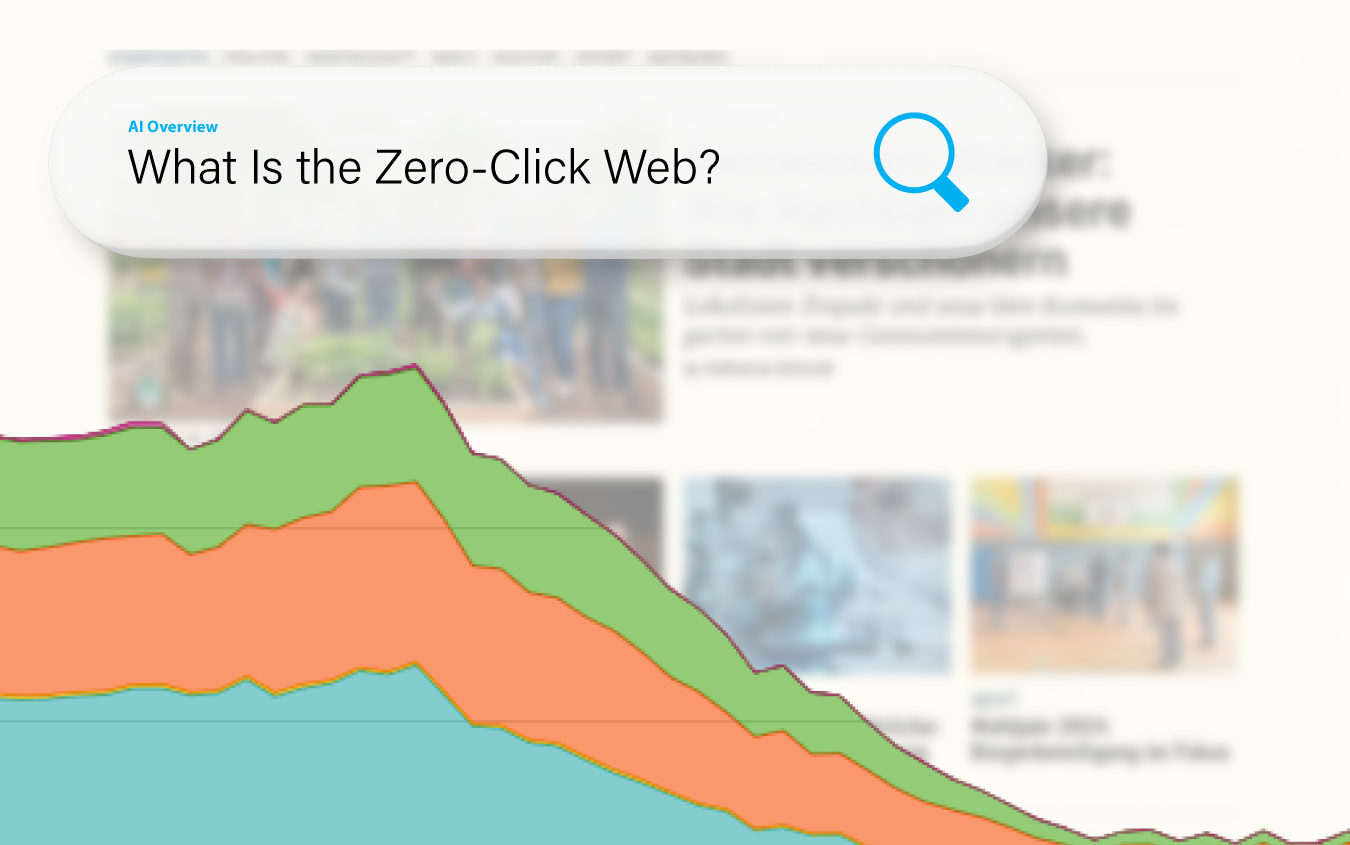
At this year's Google I/O, it became very clear that search is undergoing a fundamental transformation: Google is significantly expanding its ‘AI Mode’, putting generative AI responses to the centre and deeply integrating agent-based functions into search.
This development has drastic consequences for journalistic content. When Google answers user queries directly on its own platform - often based on content produced by publishers - the so-called ‘zero-click web’ emerges. Users no longer need to leave the Google environment, resulting in significant traffic loss. Studies are already showing a decline in search queries between 33 and 89 percent. In addition, ‘Gemini Spark’ processes information needs proactively in the background through personalised agents. The ‘Daily Brief’ offers connected services and news sources tailored to individual users. And users can create their own Google News mini apps. All this leading to zero-click becoming the new normal.
However, this shift towards an ‘answer engine’ also leads to new legal responsibilities for Google. A landmark ruling by Munich Regional Court I on 28 May 2026 (Case No. 26 O 869/26) sends a clear signal. The court decided that Google can be held directly liable for false statements in its AI-generated overviews. The judges made clear that AI-generated summaries are no longer just search results, but constitute independent content created by Google itself, for which the company must assume responsibility. This is only a small first step, given the numerous other lawsuits and legal actions against Google and other LLMs, a significant resistance is taking shape.
The Munich ruling is an important milestone for our industry. For publishers, however, the current market developments direct to one important conculsion:
You can no longer rely on SEO traffic. To achieve long-term success, the focus must shift even more towards building a direct relationship with readers. It is essential to leverage one’s own data sovereignty, protect content from bots, and consistently convert your own reach into loyal registered or paying users.
Let’s drive this development forward together!
Christian Hasselbring is responsible for Business Development at Upscore.
P.S.: The importance of European alternatives in this context is highlighted by the US government’s ban on Anthropic’s Fable 5 and Mythos 5 models, imposed on Friday. It is no longer inconceivable that something similar - or even worse - could happen to one of the models underpinning Google’s AI Mode.