
 Insight
 Engage
 Convert
 Data
Data
 Grip
Grip
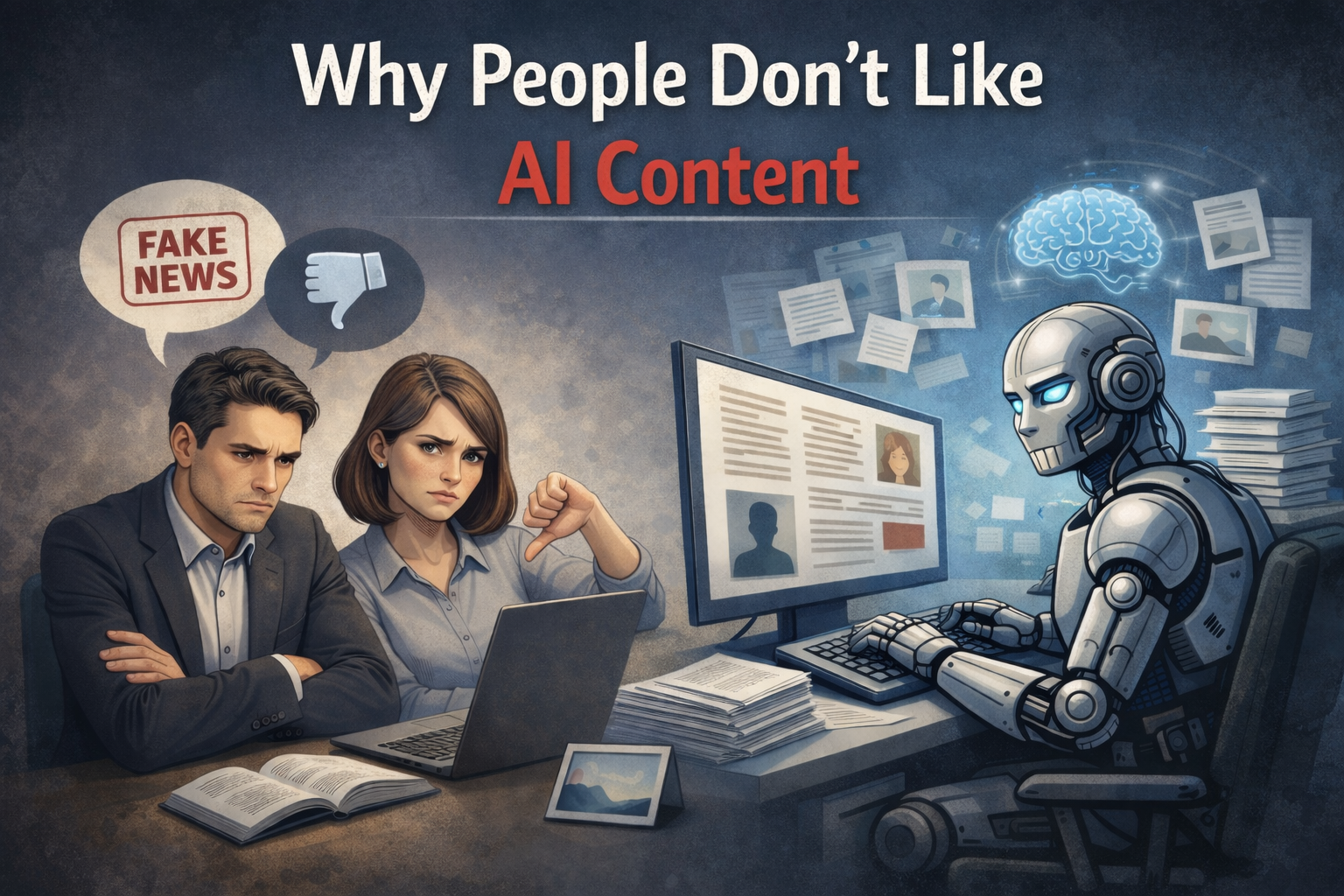
By late 2025 and early 2026, the signals are becoming clearer: AI will remain omnipresent across the web — but a reordering of trusted sources is underway. After years of exponentially growing synthetic content, a new trend is beginning to emerge:
People are increasingly seeking out content created by other people again - content shaped by experience, interpretation, and visible authorship, rather than flawless surfaces.
Notably, this shift is not driven by nostalgic backlash, but by overload. Platforms are flooded with technically perfect images, videos, and texts whose quality no longer serves as proof of authenticity. Even Adam Mosseri, Head of Instagram, has openly stated that visual perfection today tends to generate mistrust rather than credibility. The logic has reversed: what looks too polished is automatically perceived as artificial.
At the same time, the behavior of younger users is measurably changing. Public feeds are losing relevance, while private groups, direct messages, and ephemeral formats are gaining ground. Trust is shifting away from the content itself toward the question of who is sharing it. It’s no longer the image that matters, but the sender. Not polish, but context.
This dynamic is also reflected in the market. Studies show that while over 80 percent of marketers use generative AI, only a negligible fraction actually trust AI-generated content. User-generated content (UGC) remains a core component of strategy for nearly four out of five marketing leaders, while AI content is perceived by a clear majority as irrelevant or even harmful. More than one third of consumers demonstrably react more negatively to brands that visibly rely on AI-generated advertising.
Particularly interesting in this context is the rise of Reddit. The platform benefits from prioritizing discussion over perfect answers - not a single outcome, but multiple perspectives. Research into the actual composition of content shows that AI does play a role there as well: depending on the study, the share of AI-assisted or AI-generated content ranges between roughly 9 and 15 percent. What matters, however, is this: Reddit is not used because purity or authenticity is guaranteed, but because users can witness in real time how disagreement emerges in threads, how errors are corrected, and how positions evolve through community exchange.
For typical advice-oriented search queries such as “best X,” everyday problems, or product reviews, Reddit threads now often rank ahead of classic, SEO-optimized articles from established publishers. Search engine updates increasingly prioritize the most contested discussion over the smoothest answer.
This also brings renewed relevance to an old concept: the so-called Dead Internet Theory, which describes a web dominated by bots and synthetic activity. What we are observing today is no longer a theoretical debate, but a practical response. Users are adapting their behavior. They are deliberately seeking out spaces where human experience remains visible - even if it is messy, contradictory, or incomplete.
For publishers, this is an encouraging development. Human-created content is not being displaced, but elevated — not despite AI, but precisely because of its presence. Those who want trust must create room for disagreement - through comments, community formats, or Q&As - rather than simply adding another layer of AI polish. Trust is built less through flawless surfaces and more through transparency. Authenticity has become scarce - and therefore a clear competitive advantage once again.
Peer Weise is Business Solutions Manager at Upscore.